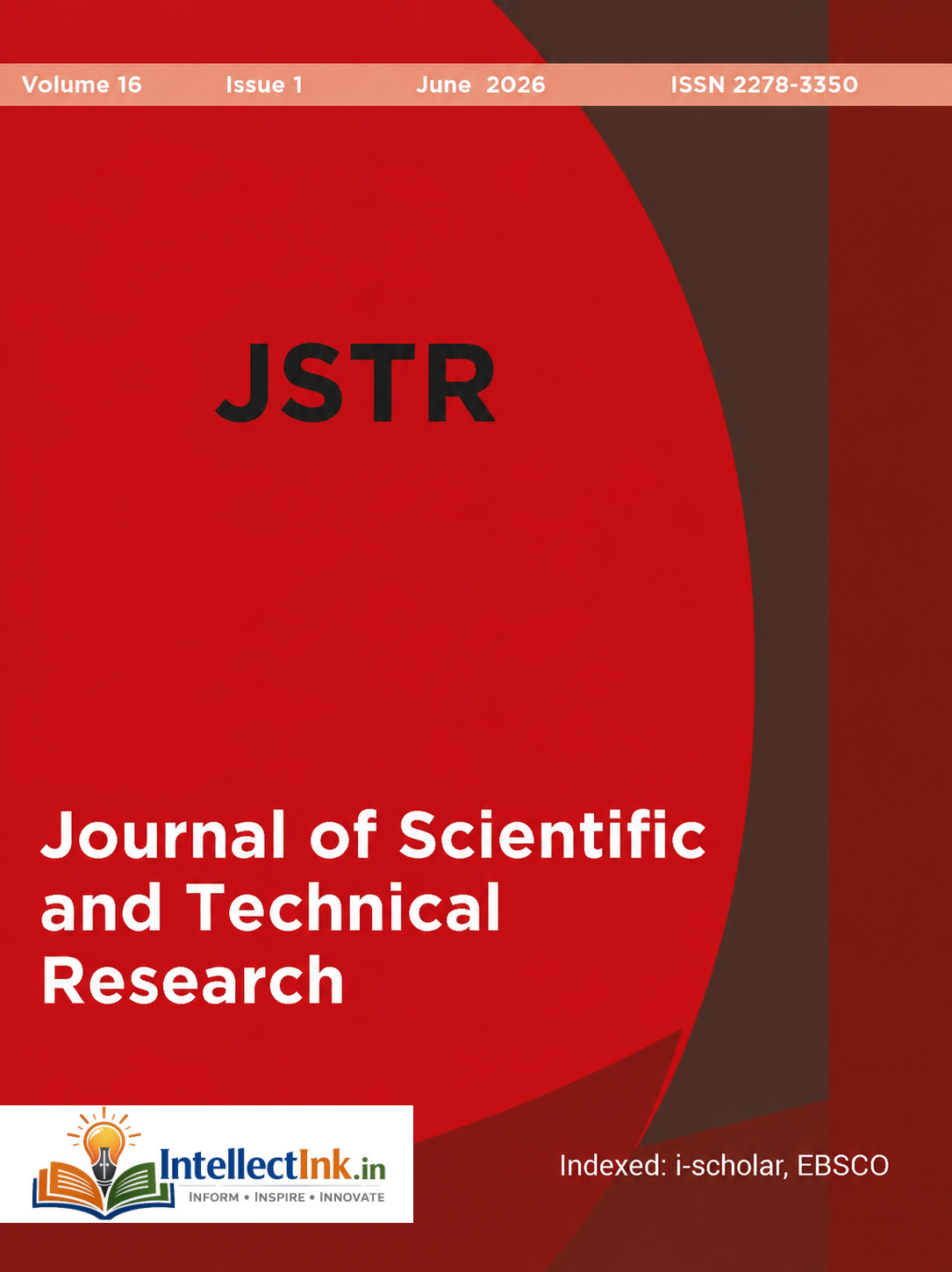
Journal of Scientific and Technical Research
About Journal of Scientific and Technical Research
The Journal of Scientific and Technical Research (JSTR), published by Intellectink Research Group, is a multidisciplinary, peer-reviewed academic journal dedicated to advancing knowledge in the fields of science and technology. Since its inception in 2011, the journal has served as a platform for researchers, academicians, and industry professionals to disseminate high-quality, original research and foster intellectual exchange at a global level.
JSTR publishes a wide range of scholarly contributions, including original research articles, review papers, and short communications, with a strong emphasis on originality, scientific rigor, and practical relevance. The journal aims to bridge the gap between theoretical research and real-world applications by promoting studies that demonstrate innovation, interdisciplinary integration, and technological impact.
The scope of the journal is broad and inclusive, covering both fundamental and applied research across diverse disciplines such as materials science, physics, chemistry, biological sciences, mathematics, statistics, environmental science, geology, medical sciences, and various branches of engineering and technology. Special consideration is given to interdisciplinary research that addresses emerging challenges and offers solutions with industrial or societal significance.
Through a rigorous peer-review process and commitment to academic excellence, JSTR ensures the credibility and quality of published work while enabling timely dissemination of research findings. By connecting scholars from academia, research institutions, and industry worldwide, the journal plays a vital role in strengthening research culture, encouraging collaboration, and supporting innovation in rapidly evolving scientific and technological domains.
Language: English Mode: Online Starting Year: 2026
Copyright: Sharda University Publisher: Intellectink Research Group
Aim
The Journal of Scientific and Technical Research (JSTR) aim to serve as a dynamic global platform for the dissemination of high-quality, original research that advances scientific understanding and drives technological innovation. The journal is committed to promoting excellence in research by publishing work that is methodologically sound, intellectually rigorous, and relevant to contemporary scientific and industrial challenges.
JSTR seeks to foster interdisciplinary dialogue and collaboration by bringing together researchers, academicians, and industry professionals to share novel ideas, emerging technologies, and impactful discoveries. The journal particularly encourages contributions that bridge the gap between theoretical research and practical application, supporting sustainable development and technological progress.
Scope
JSTR adopts a broad, multidisciplinary scope encompassing both fundamental and applied research across a wide spectrum of scientific and technological domains. The journal welcomes original research articles, review papers, case studies, and short communications in, but not limited to, the following areas:
- Physical Sciences: Physics, Chemistry, Materials Science
- Life Sciences: Biology, Biotechnology, Botany, Zoology, Medical and Health Sciences
- Mathematical Sciences: Mathematics, Statistics, Computational Science
- Earth & Environmental Sciences: Environmental Science, Geology, Climate Studies, Sustainability
- Engineering & Technology: Mechanical, Civil, Electrical, Electronics, Computer Science, Information Technology, and emerging technologies such as Artificial Intelligence, Data Science, and Nanotechnology
The journal places special emphasis on:
- Interdisciplinary and cross-domain research
- Innovative and emerging technologies
- Research with industrial, societal, or environmental impact
- Sustainable and solution-oriented studies
JSTR encourages submissions from academia, research institutions, and industry worldwide, aiming to promote knowledge exchange, research collaboration, and innovation across disciplines.
Shri Pradeep Kumar Gupta, Chancellor, Sharda University
Shri Yatendra Kumar Gupta, Pro-Chancellor, Sharda University
Dr. Sibaram Khara, Vice - Chancellor, Sharda University
Shri Prashant Gupta, Executive Director, SGI
|
Dr. V. M. Katoch, Former Secretary, Department of Health Research, Prof. Seyed E. Hasnain Prof. Ahmed Abdala Prof. Rameshwar Adhikari Prof. B. Middendorf, University of Kassel, |
Dr. Ravi P. Singh, Principal Advisor to Chancellor Prof. R. S. Dubey, Chancellor,
Prof. Martin F Desimone, Debasish Roy, Department of Dr. Narsingh B. Singh, University of Maryland, |
Dr. Bhuvnesh Kumar, Dean Research, Sharda University, Plot No. 32, Knowledge Park III Greater Noida - 201306, UP
Email: bhuvnesh.kumar@sharda.ac.in Profile: https://www.sharda.ac.in/about/leadership/dr-bhuvnesh-kumar/
Executive Editor
Prof. N. B. Singh Dept of Chemistry and Biochemistry, Sharda University, Plot No. 32, Knowledge Park III Greater Noida - 201306, Uttar Pradesh
Email: n.b.singh@sharda.ac.in Profile Link: https://www.sharda.ac.in/faculty/details/nakshatra-bahadur-singh
Dr. Mohit Sahni, Associate Dean Research, Sharda University,
Plot No.32, Knowldege Park III, Greater Noida - 201306 Uttar Pradesh
Email: mohit.sahni@sharda.ac.in Profile Link: https://www.sharda.ac.in/faculty/details/mohit-sahni/
Dr. Lalit P. Chandravanshi, Assistant Dean Research, Sharda University,
Plot No.32, Knowldege Park III, Greater Noida - 201306 Uttar Pradesh
Email: Lalit.chandravanshi@sharda.ac.in Profile Link: https://www.sharda.ac.in/faculty/details/dr-lalit-pratap-chandravanshi/
|
Prof. B. C. Tripathi, SSBT, SU baishnab.tripathy@sharda.ac.in https://www.sharda.ac.in/faculty/details/baishnab-charan-tripathy/ Dr. Nirupma Gupta, SMSR, SU Dr. Karuna Singh, SAHS, |
Dr. R. C. Singh, SSES, SU Dr. Dolly Wittal, SAS, SU Dr. M. Siddarth, SDS, SU Dr. Piyush Mittal, SOP, SU |
Dr. Sudeep Varshney, SSCSE, SU Dr. Shyamal K. Banerjee, SSES, SU Prof. R. Sreerajakumar, SNSR, SU |
|
Office of Dean Research |
Tel: 0120-2329730 |
The print version of the Journal has been indexed in i-Scholar and EBSCO databases
Journal of Scientific and Technical Research (JSTR) is a peer-reviewed scientific biannual research journal addressing both applied and theoretical issues. The Journal is being published since December 2011.
The scope of the journal encompasses research articles, review articles, and short communications in the field of applied and theoretical sciences, materials science, biology, chemistry, physics, mathematics, statistics, zoology, botany, biotechnology medical sciences, environmental sciences, geology and all branches of engineering science and technology. Articles in interdisciplinary areas with potential technological implications are strongly encouraged. Journal of Scientific and Technical Research particularly aims at publishing the finest peer-reviewed research in all fields on the basis of its originality, importance, interdisciplinary interest, accessibility and useful conclusions. The accepted papers are published within 12 weeks. There are no processing or publishing charges. Indexing of the journal in different data bases is in process.
Instructions for Authors
Thank you for choosing to submit your paper to Journal of Scientific and Technical Research (JSTR). These instructions will ensure we have everything required so your paper can move through peer review, production and publication smoothly. Please take the time to read them and follow the instructions as closely as possible.
Submission of Manuscript
Journal of Scientific and Technnical Research (JSTR) receives all manuscript submissions electronically via its Manuscript Central website located at: http://www.intellectink.in
The journal publishes the following types of manuscripts:
(i) Full papers
(ii) Communications
(iii) Reviews
Manuscript Central allows for rapid submission of original and revised manuscripts as well as facilitating the review process and internal communication between authors, editors, and reviewers via a web-based platform. For Manuscript Central technical support, you may contact the Editor-in-Chief, Prof. Bhunvesh Kumar (bhuvnesh.kumar@sharda.ac.in), or the Managing Editor, Dr. Lalit P Chandravanshi (Lalit.chandravanshi@sharda.ac.in) or Editor Dr. B C Tripathi ( baishnab.tripathy@sharda.ac.in ).
Some of the following outlines may be useful for preparing Manuscript and it Organization:
General: Manuscripts should be formatted for A4 or Letter page size using 1.15 spacing and with a margin of at least 1.8 cm all around.
The first page of the manuscript should include:
(i) The title (bold, 14 font size, centre text, times new roman) of the paper that describes the content succinctly;
(ii) The names of all the authors (normal text, 12 font size, centre text, times new roman) with at least one forename in full
(i.e. Vinay K. Verma) for each; the corresponding author should be indicated with an asterisk (*);
(iii) The address of the authors (normal text, 10 font size, centre text, times new roman); if there are multiple addresses, put
each one with the author’s name; a valid email address of corresponding author shown as (*) must be included;
Length of Manuscript
The maximum preferred length for original articles is 25 pages (including figures and tables). Communications should not exceed 1000 words and reviews should not exceed 35 pages. Authors should append the tables, figures, and calculation at the appropriate places in running text only.
Language
Original articles, communications and reviews must be written in English which will be published in English only. An abstract must be supplied of not more than 200 words in length, which summarizes the significant findings and coverage of the paper, and should be understood without reference to the text. Communications should have abstracts limited to 150 words.
Keywords
Each paper must have three to seven keywords.
Format of Manuscript
The manuscript should be organized in the following order: Abstract, Keywords, introduction, Experimental, Results and Discussion, Conclusions, Acknowledgments, References, and, where necessary, Supplemental Materials. An experimental procedure is required for communications. A shortened version of the title to be used as the running head is required (no more than 50 characters) should be supplied. 12-Point font in Times new roman is expected. Manuscripts not corresponding to the appropriate format will require author correction.
Experimental
The experimental should include a paragraph outlining the instrumental methods, mathematical modelling and computational procedures used (which ever applicable to you).
Abbreviations
Use of standard abbreviations is expected throughout, and are used without periods: examples include mp, °C, K, min, h, mL, cm, mol, ppm, TLC, J. The use of SI units is preferred.
Tables
Every table must be referred to in the text. Tables are to be numbered sequentially. A short, descriptive title should appear above each table with a clear legend and any footnotes suitably identified below. All units must be included. Tables should be created in Microsoft Word whenever possible.
Figures and Illustrations
Every figure and scheme must be referred to in the text, sequentially numbered, and include a caption. Digital files are recommended for illustrations (line drawings, halftones, photographs, photomicrographs, etc.) and should be of at least 300 dpi quality (600 dpi is preferred for schemes and line art); JPEG format; and sized to fit on a journal page. Lettering must be of sufficient size so that it is legible upon reduction as needed.
References
References are indicated in the text by consecutive numerals in square bracket i.e. [1]. The full list should be collected and included at the end of the paper in numerical order under the heading “References.” Listed references are required to be complete but without the title of article. Author first name should precede their last name (as V. K. Verma); journal title abbreviations should conform to Chemical Abstracts style. Authors are encouraged to use Microsoft Word for collecting and numbering references for consistent style and rapid editing. Responsibility for the accuracy of the reference rests with the authors, and use of a suitable style guide is recommended. Multiple references that are related can be identified with letters and given under a single citation.
Global Research Network
Publish your work in peer-reviewed international research journals.